
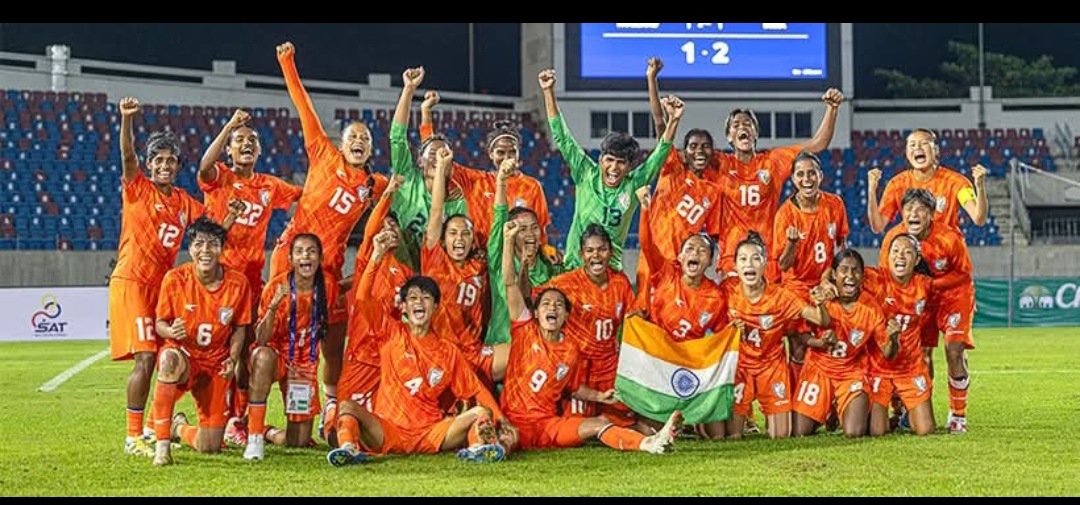
Kolkata : On July 5, 2025, the Indian women’s football team carved out a new chapter in their journey—one built on resilience, not reputation. With a gutsy 2-1 win over Thailand at Chiang Mai Stadium, India booked their spot at the 2026 AFC Women’s Asian Cup—for the first time, on qualification merit alone. No automatic berth. No home advantage. Just sheer performance.
As Sangita Basfore dropped to her knees after scoring a decisive brace, it wasn’t just celebration—it was a silent scream of vindication. Her tears told a story of struggle, sacrifice, and a group of women who never stopped believing, even when the system gave them little reason to.
“We Were Never Favourites, But We Refused to Be Forgotten”
India arrived in Thailand with little momentum. Four straight defeats had knocked them down to 70th in the world, and their camp had no full-time head coach. Most expected an early exit—especially against a host nation ranked over 20 places higher.
But Sangita had other plans. Her two goals didn’t just turn the match—they rewrote expectations. And this wasn’t luck. It was the payoff of years of quiet perseverance.
India’s path to qualification wasn’t paved with favours. It was built match by match: a 13–0 demolition of Mongolia, a 5–0 drubbing of Iraq, and a 4–0 sweep over Timor-Leste. No reliance on stars, no fixed lineups—22 players were rotated, every one of them ready to step up.
Burning Under the Sun: The Harsh Reality at Home
These players now return to a domestic league that does little to foster growth. The Indian Women’s League (IWL) remains underfunded, under-televised, and largely ignored. Despite their national heroics, players often return to club setups with poor infrastructure and little medical or nutritional support.
In the national camp, the situation has barely been better. Coaching changes were frequent, often mid-season. Players went years without structured camps or a consistent tactical identity. And still—they showed up. They worked. And they won.
Sangita’s tears in Chiang Mai weren’t just about goals. They were about battles no one saw—injuries played through, paychecks delayed, and dreams shelved and revived, season after season.
Mismatch in Momentum: Comparing Men’s and Women’s Teams
While the women were scripting history, the men’s team faltered. Back-to-back disappointments in the Asian Cup qualifiers—a tame draw with Bangladesh and a loss to Hong Kong—underlined the gap.
Despite increased investment, the men haven’t delivered consistent results. Meanwhile, the women, despite minimal backing, keep defying the odds. The contrast is sharp and telling.
Case in point? The men were promised $50,000 for beating Hong Kong. The women? They’ll receive the same amount for qualifying for a continental championship. The value placed on performance couldn’t be clearer—and it doesn’t flatter the system.
The Wage Wall: A Gulf Too Wide to Ignore
The numbers lay bare the disparity. While male stars in the ISL pocket ₹40-70 lakhs a year, female internationals often earn ₹7-10 lakhs at best. Even the top-paid women struggle to cross the ₹12 lakh
Forward Together: A Future That Needs Fuel
The Blue Tigresses have shown that talent can overcome adversity—but only up to a point. To reach Australia 2026 or the 2027 World Cup, they need more than just belief. They need resources, structure, and exposure.
That means full-time coaching staff. Year-round national camps. Regular international friendlies. Equal daily allowances, better facilities, and a reformed IWL that supports careers—not just one-off wins.
The men’s game also needs to self-reflect. It’s time their results matched the financial faith poured into them. And it’s time to ask: are we rewarding merit, or maintaining a broken hierarchy?
This is more than a sports story. It’s a reflection of inequality, of perseverance despite systemic neglect. The Blue Tigresses have earned the right to stand tall—not just because they won, but because they’ve shown what’s possible when grit meets opportunity.
They’ve done more with less. Now imagine what they could do with more.