

Kolkata: One random Monday evening, just two days after scoring four goals and providing an assist for Inter Miami, Lionel Messi decided that his time with Argentina was over. At 39, Messi had just produced another performance that made his age feel irrelevant. He scored four times in Inter Miami’s 7-1 win over CF Montréal, added an assist and looked, once again, like the player who had spent more than two decades making football seem ridiculously easy. And then, on August 31, he announced his retirement from international football. There was no grand farewell. No final night at the Monumental. No perfect goodbye. Just a decision from a man who had already given Argentina 21 years, 207 appearances and 125 goals.
It is almost strange that the story ends this way because Messi’s Argentina career was never supposed to become this long. There was a time when he thought it was already over.
Go back to 2016.
On June 26, Argentina lost the Copa América Centenario final to Chile on penalties at MetLife Stadium. Messi missed Argentina’s first penalty in the shootout. He sat on the pitch, devastated, while Chile celebrated another triumph. It was the fourth major final Messi had lost with Argentina, following the 2007 Copa América final, the 2014 World Cup final and the 2015 Copa América final. He had reached the biggest stages again and again, but the trophy kept slipping away. At 29, after another night of heartbreak, Messi announced his retirement from international football. “I’ve done all I can,” he said.
For a moment, Argentina had lost Messi. And Messi thought Argentina had lost him too.
But the country did not let him go that easily. Supporters wanted him back. His teammates wanted him back. Messi himself eventually realised that his love for the shirt was still stronger than his frustration. He returned within months, beginning a second chapter that nobody could have predicted. The player who had walked away in tears in New Jersey would eventually become the captain who lifted the World Cup.
But first, there was more pain.
Messi had been carrying Argentina’s expectations since his teenage years. He made his senior debut in 2005, after winning the Under-20 World Cup that same year, and went on to win Olympic gold in 2008. He reached the 2014 World Cup final in Brazil, only to lose to Germany. He then lost consecutive Copa América finals to Chile in 2015 and 2016. For years, every conversation about Messi with Argentina seemed to return to the same question: why could the greatest player in the world not win with his country?
Then came 2021.
At the Maracanã, Argentina beat Brazil 1-0 in the Copa América final. Ángel Di María scored the only goal, but the lasting image was Messi at full-time, collapsing onto the pitch as his teammates surrounded him. He had finally won a senior international trophy with Argentina. After years of criticism, years of finals lost and years of being compared with Diego Maradona, Messi finally had his answer. Argentina had waited 28 years for a major international title. Messi had waited even longer for his first.
And once the first one came, everything changed.
Argentina won the Finalissima against Italy in 2022 and then went to Qatar for the World Cup. Messi was 35. It was supposed to be his last chance to win the trophy that had escaped him for so long. Argentina lost their opening game against Saudi Arabia, but recovered and went all the way to the final. Against France, Messi scored twice, then scored again in extra time after Kylian Mbappé had completed a hat-trick. Argentina eventually won the penalty shootout.
Messi finally had the World Cup. He had done it.
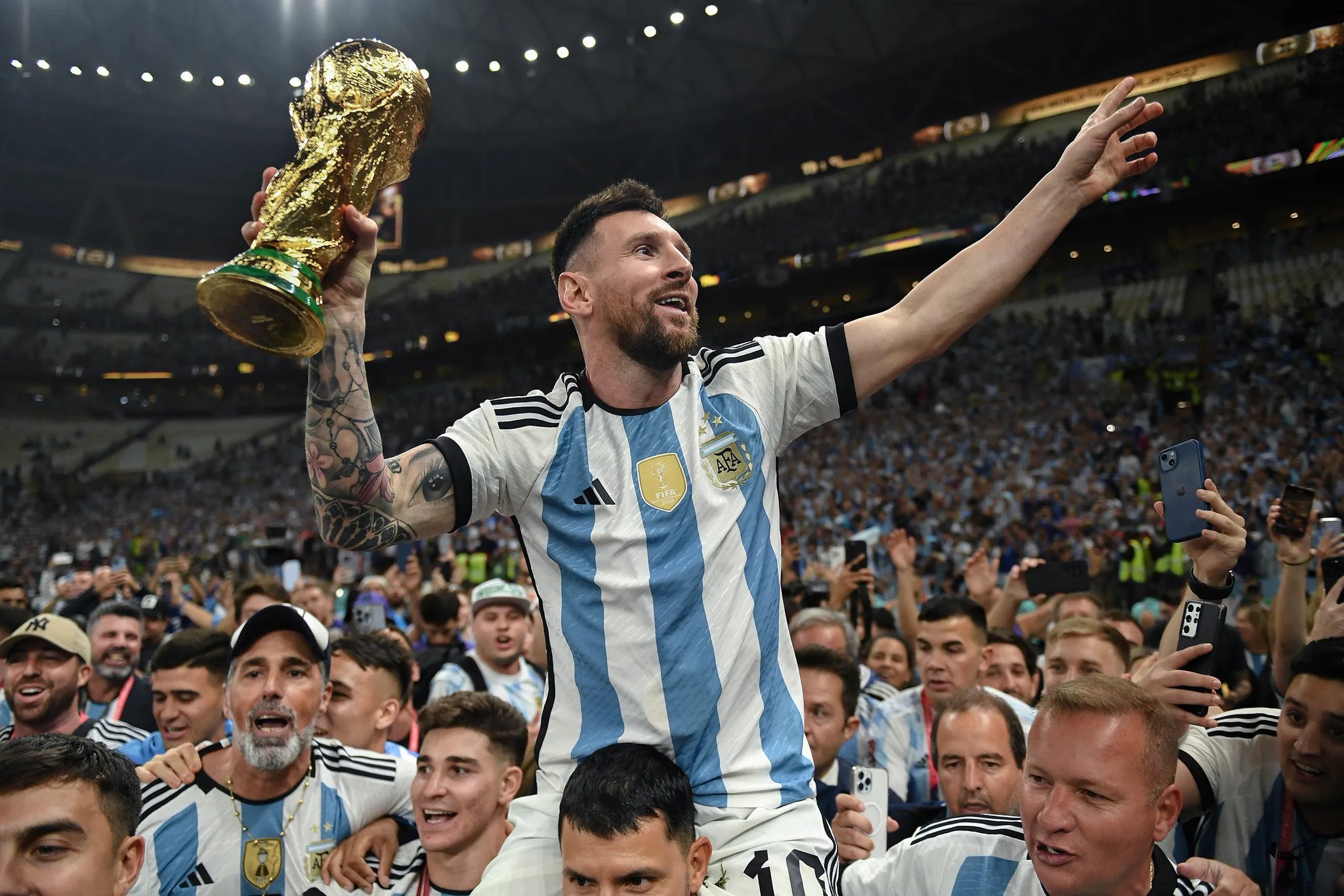
The image of him lifting the trophy in Lusail was more than a sporting photograph. It felt like the conclusion to every argument, every criticism and every painful night that had followed him since 2014. The player who had once retired because he believed he could not win for Argentina was now a world champion. He did not need to become Maradona. He did not need to answer anyone anymore. He was simply Lionel Messi, Argentina’s captain and World Cup winner.
And somehow, he still wasn’t finished.
Argentina won another Copa América in 2024, with Messi becoming the first player to appear in five Copa América finals. He was injured during the final against Colombia and left the pitch in tears, but Argentina eventually won 1-0 after extra time. By then, the relationship had completely changed. The country that once questioned Messi now feared the day he would stop playing.
Then came 2026.
Messi played his sixth World Cup and led Argentina back to the final. This time, there was no trophy. Spain beat Argentina 1-0 after extra time. It was Messi’s final game for the national team, although nobody knew it at the time. He had finished another World Cup campaign with eight goals and ended his World Cup career with 21 goals overall. Argentina had not retained the trophy, but Messi had once again taken them to the final.
Then came the part that perhaps explains why the goodbye arrived now.
On August 7, Messi’s father, Jorge Messi, died at the age of 68 after a long illness. Jorge had been far more than Messi’s father. He had been his son’s agent and one of the most important figures behind his career from the very beginning. In an emotional tribute days later, Messi admitted that he did not know how to move forward without him. He also revealed something that, in hindsight, feels like a quiet warning about what was coming.
“I only played football,” Messi wrote, before admitting that he had “quite a few doubts” about whether he would continue doing it for much longer.
Those words were written in grief. But they were also honest.
Messi revealed that his father had repeatedly asked him to play in one last World Cup. Jorge’s health had deteriorated shortly before the tournament, and Messi had hoped he would be able to watch him. Argentina reached the final, but Jorge never got to see it. Messi later admitted that he pushed himself through the tournament because he wanted to fulfil that final wish. Argentina lost to Spain, and shortly afterwards Messi lost his father.
So when Messi announced his retirement from Argentina on August 31, the decision did not feel completely sudden anymore.
The goodbye had already begun.
Messi leaves with 207 appearances and 125 goals, both Argentina records. He leaves with a World Cup, two Copa América titles, the Finalissima and Olympic gold. He leaves having gone from the player who could not win anything with Argentina to the player who delivered almost everything the country could have asked for.
But those numbers are not really the story.
The story is Messi sitting on the MetLife pitch in 2016, thinking he had failed.
The story is Messi crying at the Maracanã in 2021 because, finally, he had won.
The story is Messi lifting the World Cup in Qatar.
The story is a father asking his son to play one more World Cup.
And the story is that son eventually realising there was nothing more left to give.
In 2016, Messi walked away because he thought Argentina had asked too much of him.
In 2026, he walks away knowing he gave them everything.
That is the difference.
He leaves as Argentina’s most-capped player, its greatest goalscorer, its World Cup-winning captain and the man who finally turned the country’s most painful question into its proudest answer.
For 21 years, Argentina asked Messi for one more goal, one more tournament, one more final, one more miracle.
He gave them all of it.
Now, for the first time, they will have to watch Argentina without him. And perhaps that will be the hardest part of all.