

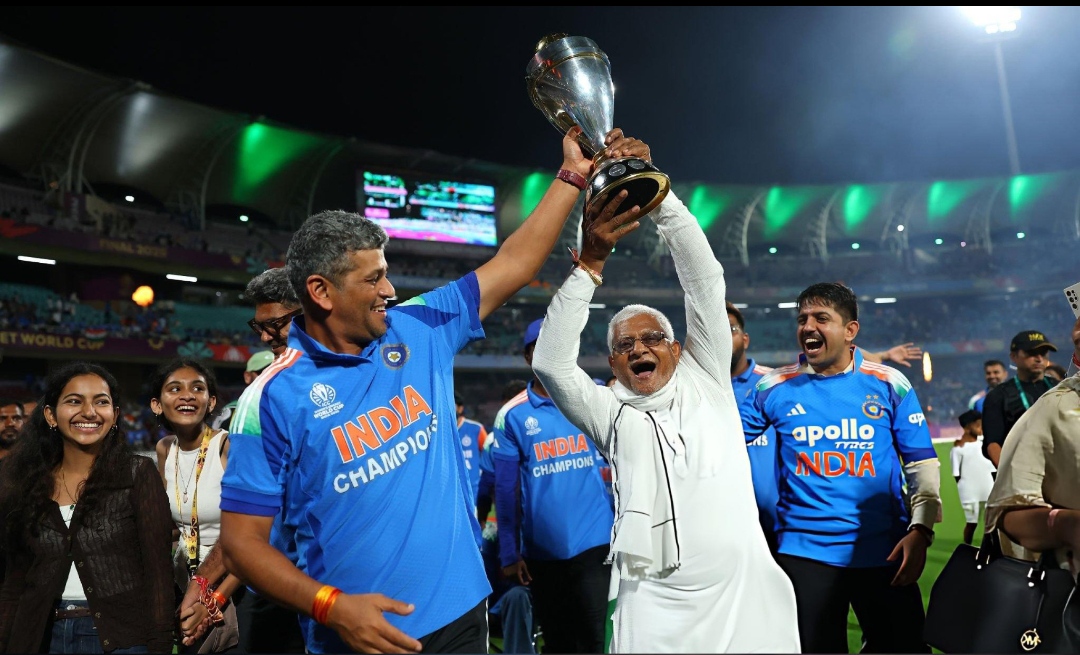
Kolkata : As Harmanpreet Kaur & Co lifted the Women’s ODI World Cup title on Sunday, the entire team basked in glory. The likes of Shafali Verma, Deepti Sharma, Smriti Mandhana, Jemimah Rodrigues, etc., were all hailed as the heroes behind the team’s maiden Women’s World Cup title. But another man stood tall behind the scenes, with tears in his eyes, as Harmanpreet’s side wrote its name in history books. That man was none other than the team’s head coach, Amol Mazumdar.
Despite never getting the opportunity to make his international debut, Amol is one of Indian cricket’s most compelling figures and also a domestic colossus. Raised in the cricketing cauldron of Mumbai, Amol attended Sharadashram Vidyamandir under the legendary coach Ramakant Achrekar, the man responsible for giving India a cricketer like Sachin Tendulkar.
Amol shared with a young Sachin for a number of years. He honed a classical, wristy batting style that relied on timing, placement, and temperament. His schoolboy feats hinted at greatness.
At 19, Amol announced himself with a world-record 260 not out on Ranji Trophy debut for Mumbai against Haryana in 1993-94, a mark that stood for nearly 25 years. Over the next two decades, he became the heartbeat of Mumbai cricket. He amassed 11,167 first-class runs at an average of 48.13, with 30 centuries, and held the Ranji Trophy run-scoring record until surpassed in later years. A dependable No. 3 or 4, he anchored innings with calm authority, often carrying Mumbai through crises.
As captain in 2006-07, he led Mumbai to their 37th Ranji title, outsmarting Bengal in a tense final. Later stints with Assam (2009-2012) and Andhra (2013-14) extended his career, but international selection eluded him. In an era dominated by Tendulkar, Dravid, Laxman, and Ganguly, the Indian middle order had no room, even for a man with India A hundreds and consistent 1,000-run seasons.
When Sachin and Kambli stitched that 664 run partnership which made them overnight stars a certain Amol Mazumdar waited for 2 days with his pads on for his chance. What he didn’t know was that this would go on for 2 decades because (sadly) Amol played at a time when India’s middle order in cricket was packed with Sachin Tendulkar, Rahul Dravid, VVS Laxman, and Sourav Ganguly. Mumbai had the longest tradition of creating cricketers such as Sunil Gavaskar, Sanjay Manjrekar, Sachin Tendulkar, and Vinod Kambli. However, Amol could not cement his international standing, as he was born in a generation when batting reserves were stocked.
His story is one of the most classical examples of cricketers “born in the wrong era”.
Retirement in 2014 marked not an end, but a pivot. Muzumdar embraced coaching with the same dedication that saw him excel in Indian domestic spectrum. He mentored India’s U-19 and U-23 teams and also worked as a batting coach with Rajasthan Royals in the IPL (2018-2020), and served as interim coach for South Africa’s 2018 tour of India. In 2021, he returned to Mumbai as head coach, nurturing the next generation.
The defining chapter in his coaching career began in October 2023 when the BCCI named him head coach of the Indian women’s team. Tasked with rebuilding after a transitional phase, Amol brought structure, belief, and tactical clarity. The 2025 World Cup tested his resolve, especially after the three group-stage losses that the Indian women’s team endured. But under his calm leadership, India bounced back at the right time, beating Australia and South Africa in the semi-final and the final to lift the coveted trophy.
It didn’t take him long to win his wards over, with his honesty and sincerity and dedication to the greater cause. He didn’t sugarcoat, and when he cracked the whip, the players knew it wasn’t without good reason. Amol gave them a serious talking-to after the four-run loss to England in Indore when victory appeared the easier proposition. Harmanpreet revealed later that the message had hit home, and the side was rejuvenated from there on.
For any team to succeed, the captain and the coach must be on the same page and share a chemistry that is imperative to drive the team forward. Harmanpreet and Amol clearly tick those boxes. In the euphoria of the historic accomplishment, Amol hasn’t been forgotten; Harmanpreet touching his feet before sinking into a long embrace revealed the Amol touch to the Indian triumph. Like Dravid will readily testify, the joy of coaching a World Cup-winning outfit almost, almost, equals the high of coveting ultimate glory as a player.