
Kolkata: Rodri led Spain to 1-0 win over Argentina in FIFA World Cup 2026 final with Ferran Torres scoring the winner in 106th minute.
Spain not only defeat Argentina but also dismantled them and shattered Messi’s dream of winning his last World Cup.
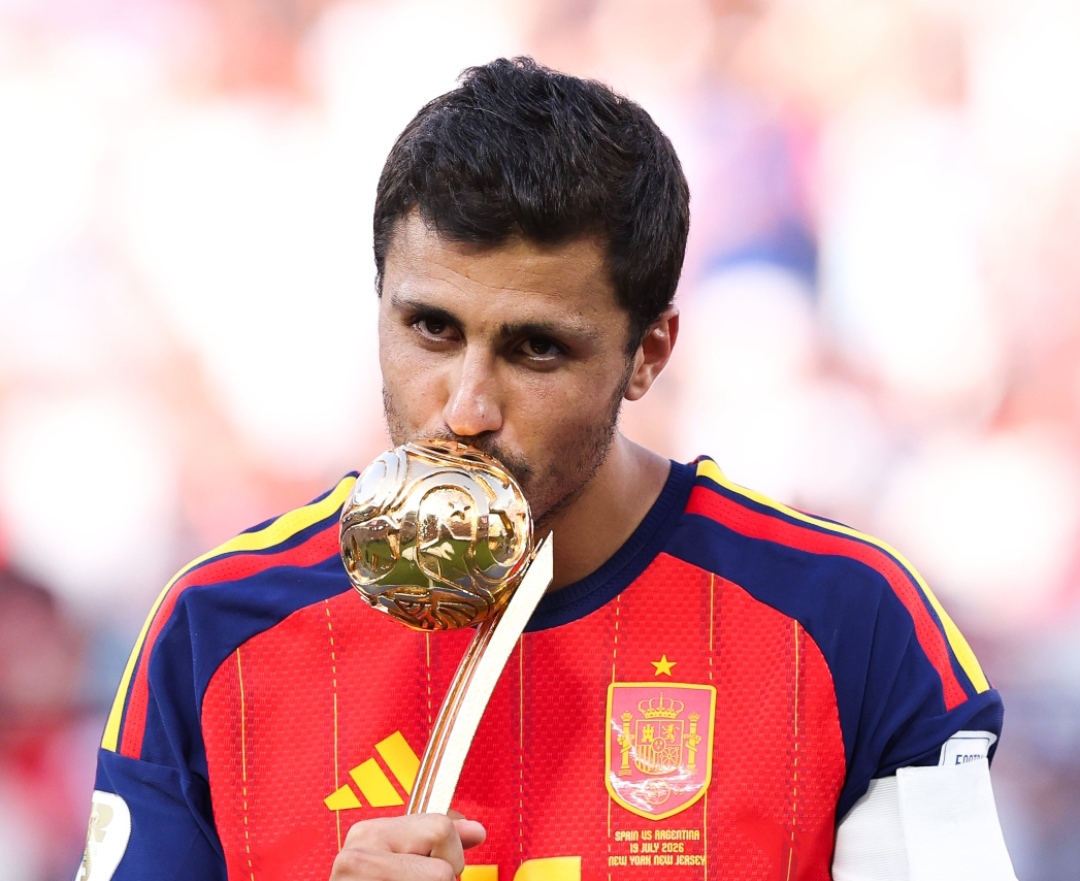
At the centre of that control was Rodri. Shortly after lifting the trophy as Spain’s captain, he was awarded the Golden Ball ahead of Messi. FIFA described him as “masterful in midfield” across Spain’s eight matches. The decision was not a sentimental reward for the champions’ captain or an attempt to manufacture controversy around Messi. It was a perfectly justified recognition of the player who most comprehensively imposed himself upon the tournament.
Messi’s stats in this World Cup at 39 was exceptional with 8 goals, 4 assists. He also assisted in semi final against England for 2 decisive goals.
However, Messi’s scoring stopped before the decisive stretch. He did not score in the quarter-final, semi-final or final. By the time Argentina reached the biggest match of the competition, his influence had become easier to contain because the team remained heavily dependent upon getting him the ball in dangerous areas.
The Spanish captain and his team excelled in those areas. Rodri didn’t need any goals to win the Golden Ball. Before the final, he had completed 648 passes – already the highest total recorded by any player at a World Cup – and maintained 93 per cent accuracy. He had also covered a tournament-high 83,802 metres and completed more high-intensity runs than any other player. Those figures describe more than safe circulation. They reveal the physical and technical scale of his responsibility.
Rodri’s importance lay in his ability to make Spain’s football sustainable.
He provided the first pass through pressure, dictated the direction of attacks and remained behind the ball whenever Spain committed numbers forward. His positioning allowed the full-backs to advance, the attacking midfielders to occupy higher spaces and the centre-backs to defend with protection in front of them.
Spain’s extraordinary defensive record was therefore connected directly to their control of possession. Opponents could not create chances without first taking the ball from Spain, progressing beyond Rodri and then attacking an organised defensive line. Almost nobody managed it.
That structure survived every kind of challenge. Spain controlled Portugal, Belgium and France before confronting the tournament’s most productive attack in the final. Argentina had scored 19 goals before arriving in East Rutherford. Against Spain, they were reduced to almost nothing. While Messi was brilliant, Rodri was a superstar in his role, spearheading perhaps the most effective aspect of the most effective team across the tournament. In wins against Portugal, France and Argentina, Rodri was immense, shepherding the load as a ball distributor while showcasing the guile to win the ball back from some of the world’s most devastating attackers.
Messi had the attacking numbers. But it’s hard to argue there was a better midfielder in this year’s World Cup than the Manchester City man.
Rodri completed 101 of his 106 passes in the final, including 57 of 61 in Argentina’s half and eight of nine long passes. He added two key passes, repeatedly carried Spain through pressure and won eight duels. He did not hide behind possession; he used it to keep Argentina pinned back and disconnected from Messi.
That is the crucial distinction. Lionel Messi accumulated the more obvious individual numbers, but Rodri controlled the environment in which those numbers could – or could not – be produced.
That is the crucial distinction. Lionel Messi accumulated the more obvious individual numbers, but Rodri controlled the environment in which those numbers could – or could not – be produced.
When the leading Golden Ball candidates finally confronted one another, Rodri performed his function, and Messi was prevented from performing his. Spain dictated the ball, the territory and the rhythm. Argentina spent almost the entire final reacting.
Rodri entered the final after being Spain’s central organiser throughout an unbeaten campaign. He then reinforced his claim on the biggest stage by controlling the midfield against the other principal candidate.
Messi entered with superior attacking production but produced no goal, no assist and no decisive attacking passage. Argentina’s first attempt arrived with three minutes of extra time remaining. That was not simply one quiet performance. It was the complete success of Spain’s plan and the clearest demonstration of Rodri’s influence.
Rodri captained the champions, controlled possession, protected the best defence in World Cup history, set passing and physical benchmarks, and delivered when the tournament reached its most demanding stages.
Messi produced the more spectacular headline statistics. Rodri produced the tournament’s most complete and consequential body of work.
All that amounted to Rodri hoisting the Golden Ball, joining the likes of Luka Modric, Zinedine Zidane and Oliver Kahn as non-attackers to receive the recognition. It’s hard to say it wasn’t richly deserved, even if he didn’t have the attacking stats compared to Messi or Mbappe.