

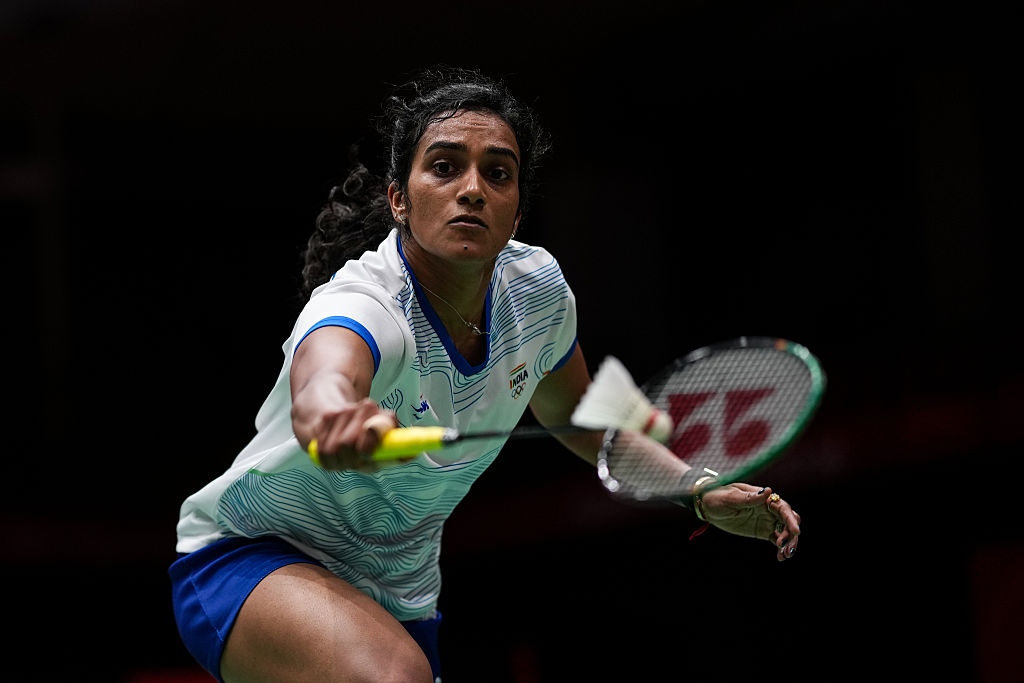
Aichi : India’s iconic Shuttler PV Sindhu has criticised the Asian Games 2026 tight badminton schedule after being forced to play three singles matches within 24 hours, stating that the cramped schedule did not provide enough time for recovery after grueling down in each matches.
The two-time Olympic medallist played her second-round match on Saturday afternoon before taking the court again for her third-round fixture later in the day. In that game, Sindhu defeated world No. 7 Tomoka Miyazaki.
That match ended around an odd time of 1:30 am local time on Sunday, leaving Sindhu with only limited recovery time before her quarterfinal against China’s Chen Yufei at around 1:30 pm, just 12 hours later, which she lost 21-11, 18-21, 10-21, ending her campaign with no medals for India in Badminton.
“Not really, Scheduling was not really well organised is what I feel,” Sindhu said when asked if she had previously played two matches at a major championship on the same day.
1 match as late as 1:30 am then next game 12 hours later at 1:30 pm, late sleep, no recovery. Sindhu voiced down these saying, “We literally slept really late and then came back in the morning, playing two matches in a day. Recovery is the most important priority.”
Sindhu said the impact of limited recovery becomes more evident during long rallies, when physical fatigue affects movement even if a player remains mentally prepared.
“It’s more than mentally preparing; you need to recover. Even though you think you are doing well, physically you might not be able to go there, or you might not be able to play,” she said. “When there are long rallies, definitely yes, recovery. When you had a good thing, you would automatically (go), but your legs don’t move.”
She added that the scheduling needed to be improved despite describing her overall performance against Chen as a good one.
To make matters worse, Sindhu’s quarter-final against WR 4 China’s Chen Yufei, was scheduled for around 1 pm the following day on Court 4 – a court without technological facilities and broadcast feed for one of the sport’s biggest names.
It wasn’t just the Indian players. Some established players from other countries, including Japanese shuttlers faced same issues.
Sindhu also raised concerns about the absence of a review system during her quarterfinal. The Court 4 at Ichinomiya Gymnasium Hall had no Hawk-Eye cameras where Sindhu played. The technology was installed only on Courts 1 and 2.
“There were no cameras here. That was really sad. I felt that 2-3 shots were on the line. In the quarter-finals in the Asian Games, there should have been a camera is what I feel,” she said.
Sindhu felt a few close line calls could have gone in her favour but players had no option to challenge the decisions.
About continuing until the 2030 Asian Games, Sindhu kept her plans open and said her immediate priority was staying injury-free.
“If I have it in me, definitely yes. I just need to stay injury-free. It’s just, what’s next? That’s very important. Step-by-step is important.
“Yeah, definitely one year at a time. It’s important that I just focus on what’s next. Because you’re not 20 anymore, right? You need to take care of your body, take care of everything. So it’s very important.
“We’ll have to pick and choose tournaments. What to do, what to play and what not to play. Because your body, taking care of your body also is important,” said Sindhu who is expected to compete in the European circuit later in the year.
As for the poor scheduling, no country has been spared for singles in Round of 32 and 16, played on same day and Quarters within 12 hours, in some cases like Unnati Hooda, PV Sindhu and Jonatan Christie. The schedule also ensured that both Chinese Men’s singles shuttlers were out before Quarters after which they became the first voices of protest.
Women’s doubles World No 1 Tan Ning told Chinese media in mixed zone, “I feel the schedule is unfair. We went to make official complaint but the chief referee didnt do anything about it. But when the Japan team complained, they actually changed the time schedule.”
Besides Sindhu, Indian Shuttler Unnati Hooda also suffered the same problem – facing top tenners inside 24 hours. The hotel was 2 hours away.
Earlier, Indian shuttler HS Prannoy, who was the part of Bronze Medal winning Men’s squad also criticized the management, called the organisation of the Asian Games mediocre, saying the lack of a Games Village took away the novelty of competing in a multi-sport spectacle unlike last edition at Hangzhou.
Prannoy was among the first to raise concerns about the scheduling with a post on X.
Speaking to the Badminton Association of India in a YouTube show on Saturday, Prannoy, a bronze medallist from Hangzhou, lashed out at the scheduling.
“A lot of people commented on my X post, saying other people are not complaining. I was about to reply saying I was not playing and I was just speaking for everybody out there, not just the Indian players,” Prannoy said.
“Because, I remember, when we finished the team event, the prize distribution took almost an hour, and it was 11:15 pm by the time we left the stadium. And it’s one hour from the stadium to our hotel. By the time we all got back, we did not have anything to eat over there like a meal. Obviously, there were snacks. You were there from 3 pm to 11 pm the day before and there is nothing around the stadium to go to and have a meal.
“All the players came back and then had a meal at 12:30 or 1 am. I remember Dhruv and Tanisha had their first match at 9 am. What if it was against a top seed or probably a higher seed? It would have been very taxing,” he said.
“I think it’s so unfair on a lot of players. I feel it’s cruel. Everybody is aiming for a good Asian Games. It comes once every four years. Just because of your problem, it shouldn’t be happening like this,” Prannoy added.
The team events in badminton at the Asian Games 2026 were scheduled between September 20 and 24, with the individual events beginning the following day, on September 25. The individual events were scheduled to end on September 29, although the Games run until October 4.
Prannoy questioned the need to wrap badminton up so early even after enough days while expressing shock at the scheduling of two matches for single players and doubles on the same day in a high intensity sport like badminton, where mental and physical recovery are important.
“Definitely, having two singles matches in a day, I have not seen that in ages. I don’t know who is scheduling it. Obviously, the 29th is the last date for badminton. But the Asian Games go on till the 4th of October. We still have five more days. I don’t understand the whole issue of not extending it by a day.
“Nobody was told anything. It’s just sad,” he said.
“It’s sad that players can’t go back to the hotel and rest and come back. I am sure a lot of players would have stayed back. It takes two hours,” he added.
India’s iconic pair Satwiksairaj Rankireddy and Chirag Shetty also voiced the scheduling issues after their shocking first-round exit.
After having been dominant in the team events, including a win over world champions Liang Wei Keng and Wang Chang of China, Satwik and Chirag shockingly lost to world No. 36 Peeratchai Sukphun and Pakkapon Teeraratsakul of Thailand in a tricky three-game affair.
“I know these situations will happen. It will get tense because it will be tricky because we are playing continuously in the team event, and we were here last night till 12 o’clock, and right away we are playing one of the good matches. So it’s not going to be easy, but we prepared,” Satwik said.
Prannoy did not hold back when it came to assessing the accommodation and the lack of a Games Village. For the first time at the Asian Games, accommodation is not centralised, but has been arranged in hotels in Aichi-Nagoya and makeshift containers on a cruise ship that has been stationed in the city’s port. At the start of Asian Games there were ruckus regarding these matter, a sight never seen before.
“Never felt we were playing the Asian Games. It felt like we were playing the Japan Open. The whole fun and the whole point of multi-sport events is you get to meet the rest of the players. There is an opportunity to mingle with them. There is an opportunity to have a conversation with them. We only felt that when we went for the opening ceremony. We generally don’t go for the opening ceremony.
“It was literally sad to be in such a situation.
“In Hangzhou, in 2023, it was mind-blowing to see how China did it. It was probably my best experience. Then, in the next edition, in three or four years, you expect things to be better, but it just went downwards. A lot of them had difficult experiences in terms of accommodation and transport.
“It was a mediocre event, to be honest,” Prannoy said.
For a tournament as big as Asian Games, the teams have been facing major issues even before the start. Dangers of flood, Accommodation problems, food issues, no proper Village, far distances between Stadium and accommodations, etc. On top of that, the issues faced by Badminton with poor scheduling. Seemed like Aichi Nagoya was never ready for it?