
Kolkata : India’s Sports Minister has issued firm warning to ISL clubs not releasing players for National duties during Monday’s meeting between club representatives, Sports Minister Mansukh Mandaviya and AIFF officials in New Delhi.
Most of the discussions were regarding future of Indian Super League, it’s commercial structure and long-term operating model, the Indian national football team also emerged as a major topic.
As per reports, AIFF President Kalyan Chaubey raised vital points regarding development of Indian Football like grooming an Indian strikers, involvement of more Indian coaches and fielding of Indian Origin (PIO) and Overseas Citizens of India (OCI) players in ISL.
WARNING TO ISL CLUBS
However, Sports Minister Mansukh Mandaviya intervened when discussions were raised by a club representative regarding fielding all Indian players in Durand Cup, Federation Cup, without any overseas.
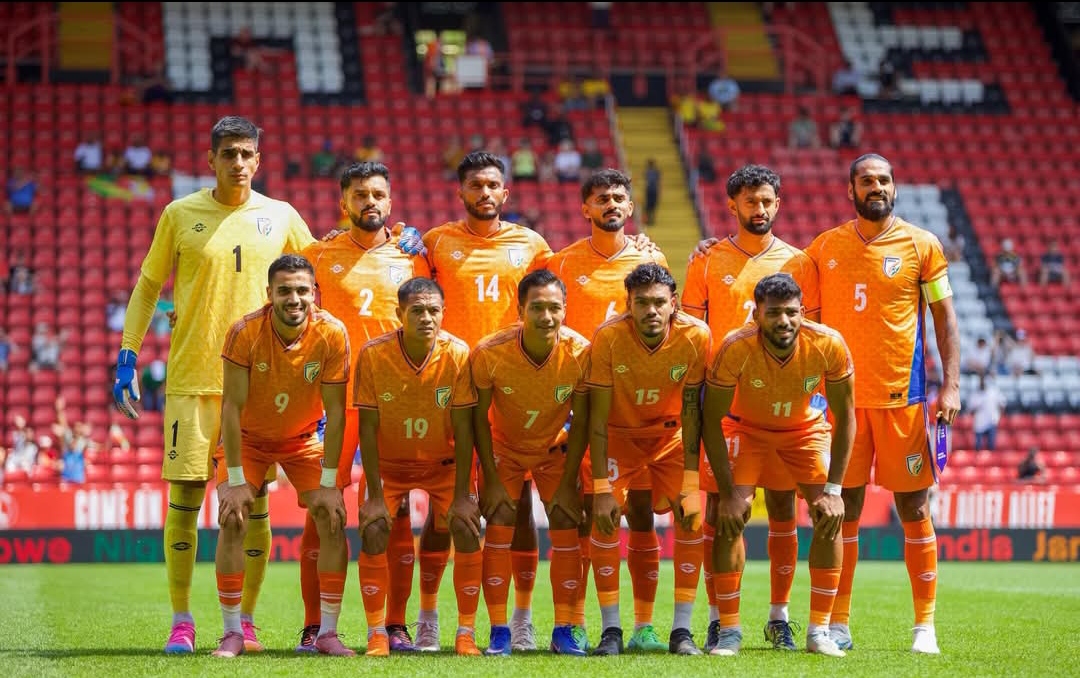
The discussion eventually took turn towards clubs withholding players from national team duty. Just before Unity Cup 2026 and Tajikistan tour, Mohun Bagan withdrew seven players from National squad. The Mariners official stated that the tournament was being held outside FIFA’s official international window, meaning players would not be covered under FIFA’s insurance programme in the event of injury. Even Kerala Blasters didn’t make players available. This in turn made difficulties for India, Khalid Jamil had to name an updated and depleted squad just 2 days ahead of the 4 nations Unity Cup, which India finished in fourth place. Earlier in many instances like CAFA Nations Cup 2025-26 , Asian Games 2023, AFC U23 Asian Cup Qualifier, etc Mohun Bagan and few other clubs withdrew their players from National duties which in turn negatively impacted team performance.
Sports Minister pointing out this strictly warned, “You can have a problem with Kalyan Chaubey or me, but don’t go against India and the national interest. If this happens again, we will take action”.
The strong remarks come at a crucial time when Club vs AIFF issue is heating up.
AIFF VS ISL CLUBS TENSIONS NEARING AN END WITH NEWLY PROPOSED MODEL ?
The AIFF has agreed “in principle” to the club-led model of running the ISL for two years and has conveyed it to the sports minister, a top official said on Tuesday.
The development appeared to have cleared the decks for the start of the 2026-27 season of the ISL in September as scheduled.
AIFF Deputy Secretary General M Satyanarayan told PTI that a final agreement will be signed and formally announced on June 15 after “ironing out some details”. He also said that 2026-27 ISL will begin on September 4.
“We have agreed in principle to the proposal made by the ISL clubs and we have told this to the Sports Minister. The sports ministry also said it’s okay. So, we will make a formal announcement on June 15.
“We also have to see how it will work legally. So, there is no final agreement as of now. We have to work on some details and iron them out. That will happen in the next three-four days.
“The kick-off for ISL is finalised, it will begin on September 4. Durand Cup will be between June 25 and July 25.” The 2026-27 ISL is expected to be a full seven-month season, with home and away matches for the 14 participating teams.
Mandaviya had asked the AIFF and ISL clubs to create a task force that would thrash out a “structured plan” for at least the next two seasons of the crisis-ridden league, in a meeting here.
The clubs had proposed a two-year club-led pilot model for the 2026-27 and 2027-28 seasons as an interim solution before any long-term commercial arrangements.
Another official, however, said that the AIFF will still own and operate the ISL.
“The clubs will be in charge of the commercial part, but that will be under AIFF’s supervision. The AIFF will still own and operate the league.
“We are doing this in the interest of the clubs, because they have also gone under losses. But we are still looking at a long-term model. At the end of two years, we are going to review the situation (club-led model).
“The clubs said at least for two years you (AIFF) allow us to do this model and then you can review it. They can later say, we’ll do it for five years or for 15 years. We will take a call at that point in time. As of now, we (AIFF) have agreed in principle the two-year model part.” He said the AIFF will also include Genius Sports in the discussions.
“We will also speak to Genius Sports. They (Genius Sport) will also be part of the whole thing. All three together will work on this.
“Moreover, the broadcast rights will have to be tendered.”
WHY THIS PROPOSED MODEL?
Previously, Genius Sports had emerged as the highest bidder for the commercial rights of the ISL after the AIFF floated the tender earlier this year. It had promised Rs 2,129 crore annually for ISL and a cup competition for the next 15+5 years, including 5% increase per year. That amounted to around Rs 64 crore per year.
Under the revenue sharing model as per the Genius Sports bid, the AIFF was to get Rs 12.4 crore in the first year. The AIFF also wanted to charge the clubs an entry fee, a proposal that has not found favour with the ISL clubs.
The clubs had opposed to Genius Sports becoming the commercial rights holders.
They instead proposed to acquire the commercial rights of the ISL for the two-year period and pay the AIFF Rs 15 crore per year to cover the costs associated with the regulatory functions that the national federation is required to discharge in its capacity as the governing body, including refereeing, legal, integrity and anti-doping support.
In their proposal, the ISL clubs had made “unequivocal” commitment that the AIFF’s role as the regulatory body of Indian football will be fully preserved and respected.
All core regulatory functions shall continue to remain exclusively with the AIFF, including referee appointment and management, legal and integrity oversight, anti-doping support and compliance, sporting regulations, player registration and transfer systems, compliance with FIFA and AFC regulations.
East Bengal FC were crowned the champions for the first time in the history of ISL ahead of arch-rivals Mohun Bagan Super Giant with the winners being decided on the concluding day of the league last month.
This season’s ISL was held in a single-leg round-robin format where all 14 participating teams competed against each other once. A total of 91 matches were played across the season, with each team playing 13 games.