
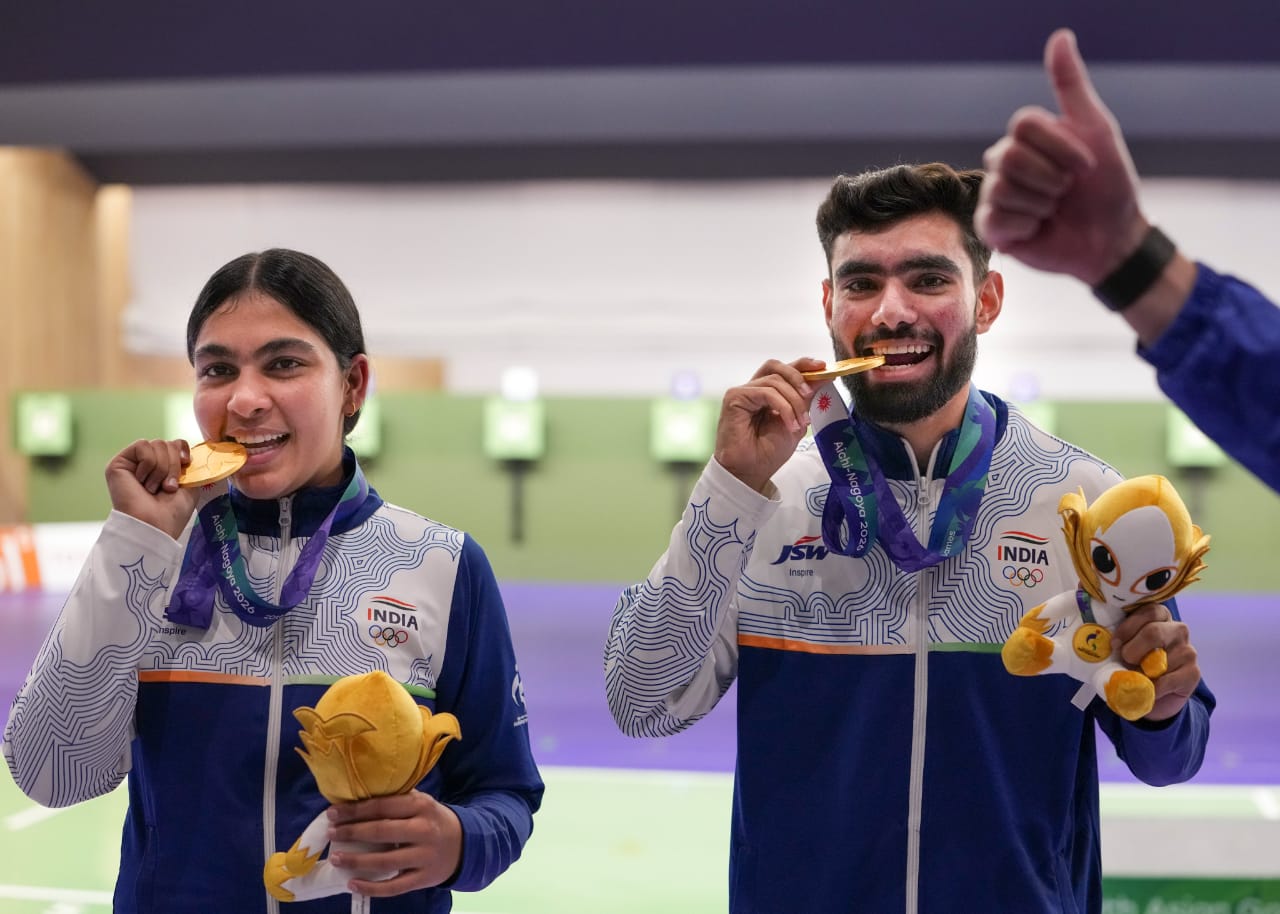
Aichi: India’s second gold of the Asian Games came in impressive fashion as Suruchi Singh and Kamaljeet combined brilliantly to win the mixed team 10m air pistol event, setting a new Asian Games record in the process. Continuing India’s strong momentum in shooting, Aishwary Pratap Singh Tomar, Rudrankksh Patil and Niraj Kumar added another medal to the tally by clinching silver in the men’s 50m rifle 3 positions team event. In athletics, Gulveer Singh clinched silver in the 10,000m, while Baranica Elangovan created history by becoming India’s first Asian Games medallist in the women’s pole vault as she secured the bronze. India enjoyed a highly successful and action-packed day, adding six medals — one gold, two silver and three bronze — on Day 6 of the Asian Games 2026 on Friday, September 25, in Aichi-Nagoya, Japan.
With six medals on Day 6, India’s medal tally moved to 23, comprising two gold, nine silver and 12 bronze, as India stood in 12th position on the medal table. The medals came across shooting, table tennis and athletics, while India also delivered several other strong performances across disciplines. In kabaddi, both the men’s and women’s teams successfully booked their places in the eagerly anticipated gold-medal finals. In squash, India assured itself of three medals as Joshna Chinappa and Velavan Senthilkumar advanced to the mixed doubles semi-finals, while Anahat Singh and Abhay Singh progressed to the last four in the women’s and men’s singles, respectively. In hockey, the women’s team continued its unbeaten run with another impressive victory, while in boxing, Sachin Siwach advanced to the men’s 60kg quarter-finals. In athletics, India also secured places in the women’s 400m final through Kiran Pahal and Prachi, while Vishal TK and Rajesh Ramesh advanced to the men’s 400m final. India, however, also endured a setback as defending badminton champions Satwiksairaj Rankireddy and Chirag Shetty suffered a first-round exit.
Surfing
India made a strong and encouraging start in the Shortboard surfing competition, with all four athletes progressing from Round 1.
In the men’s Shortboard, Kishore Kumar Anbarasu produced India’s standout performance, winning Heat 3 with a total score of 9.33. His two best waves were scored at 5.33 and 4.00. By finishing first in his heat, Kishore advanced directly to Round 3, avoiding the repechage.
Sivaraj Babu also put up a solid performance, finishing second in Heat 8 with a total score of 7.03. He recorded wave scores of 3.53 and 3.50 and will now compete in the Round 2 repechage.
In the women’s Shortboard, 16-year-old Kamali Prakash secured second place in Heat 5 with a score of 3.74, built from waves of 2.67 and 1.07. She advances to the Round 2 repechage.
Sugar Shanti Gayen finished third in Heat 3 with a total score of 3.84. Despite finishing third in her three-surfer heat, she also progressed to the Round 2 repechage, ensuring that all four Indian surfers remained in contention.
Equestrian
India finished fourth in the Equestrian Team Final with a total score of 201.971 points. China claimed the gold medal with 208.148 points, followed by South Korea with 205.265 and Japan with 204.117. Shruti Vora was India’s top scorer with 68.059 points on Magnanimous, followed by Hriday Vipul Chheda with 67.353 on Dono Di Maggio and Jai Sud with 66.559 on Goofy La Perla. Gaurav Pundir completed the Indian quartet on Milli. The event also served as the first qualification round for the individual Dressage competition.
India’s Eventing campaign, however, ended in disappointment after the team was disqualified when Arjun Nagra’s horse, Kouli Goodwood, refused two obstacles during the cross-country and jumping phase. With only three active riders remaining, India fell below the minimum requirement for a team result. The squad had already been weakened when Aan Kumar’s horse, Bolivar Gioano, tested positive for tick fever before departure. China’s Hua Tian won the individual gold, while Thailand claimed its first-ever team Eventing gold.
Fencing
India’s fencing campaign in the team events at the Asian Games 2026 came to an end, with both the men’s foil and women’s épée teams suffering defeats in the Round of 16. In the men’s foil, India’s Sachin, Hemash Singh Sanasam, Aditya Badser and Tejas Manoj Patil faced Hong Kong, China, at Aichi Sky Expo Hall F. India went down 27–45 after struggling to contain their opponents from the opening relays.
Aditya Badser provided a brief spark by scoring six touches in the third relay, while Sachin produced some clinical touches late in the contest. However, Hong Kong had already built a commanding advantage and comfortably secured the victory.
The women’s épée team, comprising Taniksha Khatri, Kanupriya Chawla, Mitva Chaudhari and Yashkeerat Kaur Hayer, also exited in the Round of 16 after losing 29–45 to Uzbekistan. India displayed tactical awareness during the bout, but Uzbekistan gradually took control during the middle relays. Their effective counter-attacking and ability to maintain the lead prevented India from mounting a comeback.
Badminton
India experienced a mixed day in the badminton individual events, with some players advancing to the next rounds while others suffered early exits.
The biggest setback came in men’s doubles, where defending champions Satwiksairaj Rankireddy and Chirag Shetty suffered a shock first-round defeat. The Indian pair, who had won gold at the previous Asian Games, started strongly by taking the opening game against Thailand’s Pakkapon Teeraratsakul and Peeratchai Sukphun. However, they were unable to maintain their momentum and eventually lost 21-12, 19-21, 14-21.
Satwik and Chirag had earlier contributed to India’s bronze-medal-winning men’s team at Aichi-Nagoya.
Hariharan Amsakarunan and MR Arjun also exited the men’s doubles competition in the Round of 32. The Indian duo were beaten in straight games by Indonesia’s Fajar Alfian and Muhammad Shohibul Fikri, losing 14-21, 11-21.
In women’s doubles, Treesa Jolly and Gayatri Gopichand survived a tough opening-round contest against Hong Kong, China’s Tsang Hiu Yan and Lui Lok Lok. The Indian pair won 21-16, 16-21, 21-16 to advance to the next round, where they will face Japan’s Yuki Fukushima and Mayu Matsumoto.
However, Kavipriya Selvam and Simran Singhi were knocked out in the opening round after losing 9-21, 5-21 to Indonesia’s Kusuma Febriana Dwipuji and Meilysa Trias Puspita Sari.
There was better news in mixed doubles, with Dhruv Kapila and Tanisha Crasto progressing to the quarter-finals. The Indian pair first defeated Maldives’ Aminath Abdul Razzaq and Nibal Ahmed 21-8, 21-7 in the pre-quarterfinals before overcoming Malaysia’s Goh Soon Huat and Lai Shevon Jemie 22-20, 24-22 in a closely fought contest.
Dhruv Kapila and Tanisha Crasto had actually played an additional opening-round match, defeating the Maldivian pair of Aminath Abdul Razzaq and Nibal Ahmed before their narrow victory over Malaysia.
In women’s singles, Unnati Hooda made an impressive start to her campaign, defeating DPR Korea’s Yi Mi Song 21-9, 21-10. She will next face Malaysia’s Wong Ling Ching in the Round of 32.
Harmeet Desai and Yashaswini Ghorpade saw their campaign come to an end after losing their mixed doubles quarter-final match against the dominant Chinese pair of Lin Shidong and Kuai Man. The Indian duo were eliminated just one step away from a medal after suffering a 3-0 defeat (11-5, 12-10, 11-9).
Shooting
India’s impressive shooting campaign reached another high point as Suruchi Singh and Kamaljeet clinched gold in the mixed team 10m air pistol event, delivering a commanding performance in the final. The Indian pair dominated the contest, combining for a total of 484.6 points, with Suruchi contributing 245.7 and Kamaljeet 238.9. Their combined score also set a new Games and Asian Games record, adding another landmark achievement to India’s strong shooting campaign. Suruchi Singh and Kamaljeet had earlier finished at the top of the qualification stage with 587 points. South Korea secured silver with 478.0 points, while Iran claimed bronze with 415.8.
India added another medal in the men’s 50m rifle 3 positions team event, with Aishwary Pratap Singh Tomar, Niraj Kumar and Rudrankksh Patil combining for a score of 1762-94x to clinch silver. China topped the event with 1766-95x to win gold, while South Korea claimed bronze with 1751-87x.
However, India narrowly missed out on a medal in the individual event. Aishwary, who qualified third with 589-34x, finished fifth in the final with 327.6 points. Niraj, who qualified fourth with 588-34x, finished eighth with 299 points, while Rudrankksh missed the final after finishing ninth in qualification with 585-26x.
China continued its dominance in the individual final, with Liu Yukun claiming gold with 360.5 points while also setting a new Asian Games record. Zhang Changhong secured silver with 360.2 points, while Kazakhstan’s Islam Satpayev took bronze with 348.3 points.
Canoe Sprint
In the men’s Kayak Double 500m, Prasanna Kumar and Prohit Baroi finished fifth in Semifinal 1 with a time of 1:40.308, missing out on a place in Final A. They later competed in Final B, where they produced a third-place finish in 1:40.411 to secure 12th place overall. Their earlier time of 1:41.141 had been recorded in their heat and was not their semifinal timing.
In the women’s Kayak Four 500m Final A, Dhanamanjuri Devi Khwairakpam, Pooja, Soniya Devi Phairembam and Parvathy Geetha finished eighth with a time of 1:45.670, ending their medal hopes.
In the women’s Canoe Double 500m, Megha Pradeep and L. Neha Devi Leichonbam finished fourth in the semifinal with a time of 2:08.306. With only the top three pairs advancing to Final A, the Indian duo narrowly missed qualification and brought their campaign to a close.
Table Tennis
India secured a historic fourth table tennis medal in Asian Games history, with Diya Chitale and Manush Shah claiming bronze in mixed doubles after producing a strong run to reach the semi-finals. In mixed doubles, Chitale and Shah delivered an impressive quarter-final performance, defeating Hong Kong, China’s Wong Chun Ting and Doo Hoi Kem 3-1 (11-6, 13-15, 11-9, 11-5) to book their place in the last four. They then faced reigning Olympic champions Wang Chuqin and Sun Yingsha of China in the semi-finals. Despite their determined effort, the Indian pair went down 4-0 (11-8, 11-5, 11-8, 11-2), but their semi-final finish secured India a valuable bronze medal.
In the singles events, Yashaswini Ghorpade advanced to the women’s singles pre-quarterfinals after overcoming Syria’s Hend Zaza 4-1. Manush Shah also progressed to the men’s singles pre-quarterfinals after defeating Iran’s Benyamin Faraji 4-0 in the Round of 32.
Sreeja Akula saw her women’s singles campaign come to an end in the Round of 32 following a 4-1 defeat to North Korea’s Pyon Song Gyong. Manav Thakkar also exited at the same stage in the men’s singles, suffering a 4-2 loss to North Korea’s U Tae Ryong.
In women’s doubles, Sreeja Akula and Syndrela Das were knocked out in the Round of 16 after losing 3-0 to China’s Kuai Man and Wang Manyu. Yashaswini Ghorpade and Diya Chitale also bowed out at the same stage, going down 3-0 to China’s Fan Shuhan and Chen Yi.
In men’s doubles, Sathiyan Gnanasekaran and Harmeet Desai fought hard to defeat Indonesia’s Affan Pratama and Muhammad Negara 3-2 and reach the Round of 16. However, their campaign ended there as they suffered a 3-0 defeat to Japan’s Sora Matsushima and Shunsuke Togami.
Manav Thakkar and Manush Shah were also eliminated from the men’s doubles competition after losing 3-1 to Japan’s Tomokazu Harimoto and Hiroto Shinozuka, bringing India’s campaign in the doubles events to a close.
Athletics
India enjoyed a highly successful day in athletics, highlighted by a historic bronze medal and two other strong podium performances. In the men’s 10,000m final, Gulveer Singh clinched the silver medal after producing a determined performance in a gruelling tactical battle. Gulveer remained perfectly positioned in the lead pack before making a decisive surge over the final 1,000m to secure second place in 28:29.38. He finished 1.87 seconds behind Bahrain’s Birhanu Balew, who claimed gold in 28:27.51. The silver marked an improvement for Gulveer, who had won bronze in the same event at the 2023 Hangzhou Asian Games.
In the women’s pole vault final, Baranica Elangovan created history by winning India’s first-ever Asian Games medal in the event. She cleared a best height of 4.15m to secure bronze, sharing the medal with Kazakhstan’s Polina Ivanova after both athletes finished level on countback. Baranica opened with first-attempt clearances at 3.85m and 4.00m before clearing 4.15m after two attempts. She then attempted 4.25m but was unable to clear the height in all three attempts, bringing her competition to an end with a historic bronze medal. Japan’s Misaki Morota won gold with a best clearance of 4.55m, while China’s Chunge Neu took silver with 4.50m. Sindhusree Ganesha was unable to register a valid mark after missing her attempts at 3.85m and 4.00m. Baranica has also enjoyed a strong season, improving the national record twice earlier in the year. She first cleared 4.22m before raising the mark to 4.23m at Bhubaneswar. Sindhushree G later improved the national record to 4.25m, while Baranica’s season-best remains 4.23m.
India added another bronze in the women’s shot put, with Manpreet Kaur producing a best throw of 17.17m on her fourth attempt to secure a place on the podium. The 36-year-old became only the third Indian woman to win an Asian Games medal in the women’s shot put, claiming her first medal at the continental event. Manpreet opened with 16.32m and steadily improved with each round before producing her medal-winning effort in the fourth round. Although she fouled her sixth and final attempt, it did not affect her position as she remained third in the field. The bronze marked Manpreet’s return to the podium after more than a decade at the senior level. She returned to competition in 2021 after serving a four-year doping ban. At the previous Asian Games in Hangzhou, she finished fifth, while earlier this year she narrowly missed a medal at the 2026 Commonwealth Games after finishing fourth with a throw of 17.49m. India’s other finalist, Krishna Jayasankar Menon, finished fifth with a best throw of 16.57m. China’s Jiayuan Song won gold with 19.40m, while compatriot Linru Zhang took silver with 18.14m.
In the heptathlon, Pooja finished sixth overall in the gruelling seven-event competition, while Anamika Aneesh completed her campaign in seventh place. In the men’s hammer throw final, Damneet Singh finished ninth, missing out on the top-eight cutoff, while Praveen Kumar finished 11th in the final classification.
India also produced encouraging performances in the 400m events. TK Vishal advanced to the men’s 400m final after clocking 45.27 seconds to finish first in his heat and secure automatic qualification. Rajesh Ramesh also progressed after recording 45.26 seconds in his heat. In the women’s 400m semi-finals, Kiran Pahal booked her place in the final after finishing second in Heat 2 with a strong time of 53.44 seconds. Prachi also advanced after finishing third in Heat 3 in 53.46 seconds, progressing as the fastest non-automatic qualifier.
In the men’s 100m semi-finals, Gurindervir Singh narrowly missed out on a place in the final after clocking 10.32 seconds to finish 11th overall. Animesh Kujur finished 18th overall across the semi-final field with a time of 10.38 seconds. Meanwhile, in the mixed relay, Bahrain claimed the gold medal in a Games-record time of 3:12.87, while Vietnam secured the bronze in 3:14.54.
Swimming
India concluded its swimming campaign at Aichi-Nagoya 2026 without a medal, with Rishabh Das producing the country’s strongest individual performance in the pool. Das finished sixth in both the men’s 100m and 200m backstroke finals, but his performance in the 200m backstroke was particularly impressive as he clocked 1:58.77 to set a new Indian national record, improving his previous mark of 1:59.84.
Four Indian swimmers progressed from the heats to individual finals. Srihari Nataraj finished 10th in the men’s 50m backstroke final in 25.52, while Sajan Prakash secured seventh place in the men’s 200m butterfly final with a time of 1:58.42. India also reached the men’s 4x100m medley relay final, where the team finished eighth.
Aryan Nehra competed in the directly contested distance freestyle finals, finishing 11th in the men’s 800m freestyle and 12th in the 1500m freestyle. Vedaant Madhavan, son of Indian actor R Madhavan, finished 19th overall in the men’s 200m freestyle heats with a time of 1:52.01 and did not qualify for the final. He also represented India in the men’s 4x200m freestyle relay alongside Sajan Prakash, Dhakshan Shashikumar and Aneesh Sunil Kumar Gowda. The quartet finished ninth in 7:24.32, narrowly missing out on a place in the final.
Squash
India assured itself of three squash medals, with Anahat Singh, Abhay Singh, and the mixed doubles pair of Joshna Chinappa and Velavan Senthilkumar advancing to the semi-finals.
In the mixed doubles quarter-final, Joshna Chinappa and Velavan Senthilkumar produced a dominant performance against the Philippines’ David Pelino and Jemyca Aribado, securing an 11-3, 11-5 victory in under 30 minutes. The Indian pair had also defeated Nepal’s Suraj Kumar Chand and Shameena Riaz 11-7, 11-10 in the Round of 16, ensuring at least a bronze medal.
The achievement holds added significance for 40-year-old Joshna Chinappa, who is competing at a record seventh Asian Games and has now secured her sixth Asian Games medal. She previously won singles bronze in 2018, team silver in 2014 and 2018, and team bronze in 2010 and 2022. Joshna will next face Hong Kong’s Yo Ka Lee and Ming Hong Tang in the semi-final.
In women’s singles, junior world champion Anahat Singh produced a commanding performance to defeat compatriot Tanvi Khanna 11-2, 11-5, 11-3 and book her place in the semi-finals, guaranteeing another medal for India. Anahat will now continue her bid for the singles gold, with the Asian Games singles champions set to earn direct qualification for the 2028 Los Angeles Olympics, where squash will make its Olympic debut.
Abhay Singh also stormed into the men’s singles semi-finals after a convincing 11-4, 11-3, 11-6 victory over Japan’s Ryunosuke Tsukue. He will face Pakistan’s Muhammad Irfan in the last four. Irfan defeated India’s Veer Chotrani 6-11, 11-8, 11-3, 11-3, bringing Chotrani’s campaign to an end.
With three Indian entries reaching the semi-finals from four quarter-final appearances, India is guaranteed at least three bronze medals in squash at the 2026 Asian Games, underlining a strong and medal-rich campaign in the sport.
Hockey
India’s women’s hockey team continued its impressive campaign by reaching the semi-finals with a fourth consecutive victory. The team defeated hosts Japan 3-1 to seal its place in the last four and maintain a perfect record in Pool B. Lalremsiami Hmarzote, Navneet Kaur and Ishika were on target as India secured its fourth win in as many matches, keeping the team firmly at the top of the group. The victory also extended India’s unbeaten run and strengthened its position heading into the knockout stage.
Esports
India began its Pokémon Unite campaign with a defeat in Group C, going down 2-0 (1-0, 1-0) to South Korea. Despite the setback, India will have an opportunity to respond in its next group match against Japan as the team continues its campaign.
Kabaddi
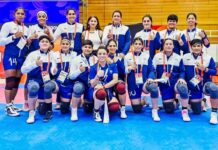
India produced a powerful double in kabaddi, with both the women’s and men’s teams storming into the gold-medal matches after commanding semi-final victories. In the women’s semi-final, India established a strong 31-17 lead over Nepal at half-time after inflicting two all-outs. Nepal started brightly, with Ganga Ghimire making an impact and producing a super raid, but India gradually took control of the contest and opened up a 14-point advantage by the interval.
The defending champions maintained their grip on the match after the break, eventually defeating Nepal 48-24 to book their place in the gold-medal match. India inflicted three all-outs during the contest, with Pooja, Sanju Devi and Sonali Singh leading the attacking charge. India will face the winner of the other semi-final between Iran and Chinese Taipei in the final.
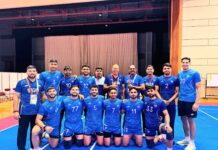
The men’s team delivered another commanding performance in their semi-final against Thailand. India took a 37-18 lead into half-time after successfully weathering a brief period of pressure from Thailand, who managed to inflict an all-out in the opening half. The defending champions quickly regained control and responded with two all-outs of their own, putting themselves in a commanding position.
India then completed a dominant 66-28 victory over Thailand to secure its place in the gold-medal match. The defending champions controlled the contest from start to finish, inflicting four all-outs and steadily widening the gap in the second half. India will meet Iran in the final, setting up another major Asian Games showdown between two of the most successful teams in the sport. Iran are the only team besides India to have won the men’s kabaddi gold at the Asian Games and famously defeated the defending champions in the semi-finals at Jakarta 2018.
Iran captain Fazel Atrachali is set to appear in his fifth Asian Games final when Iran face India. The experienced defender will draw on his long association with the Pro Kabaddi League, where he has played alongside several Indian players.
Boxing
India’s Sachin Siwach booked his place in the men’s 60kg quarter-finals after defeating former Asian champion Mohammad Abu Jajeh of Jordan 4-1 on a split decision. Siwach remained composed throughout the bout to secure an important victory and advance to the last eight, where he will face Japan’s Shunsuke Kitamoto.
Meanwhile, Preeti Pawar’s women’s 54kg campaign came to an end in the Round of 16. She suffered a 5-0 defeat against Olympic bronze medallist Pang Chol-mi of North Korea.
Weightlifting
India’s Nirupama Devi finished seventh in the women’s 63kg weightlifting competition with a combined total of 217kg. She lifted 93kg in the snatch before registering 124kg in the clean and jerk. China’s Yang Liuyue claimed the gold medal with a total of 251kg, while DPR Korea’s Pak Jin-hae secured silver with 248kg. Chinese Taipei’s Kuo Hsing-chun completed the podium with a bronze-medal-winning total of 237kg.