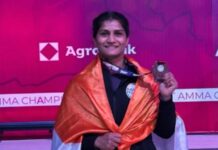

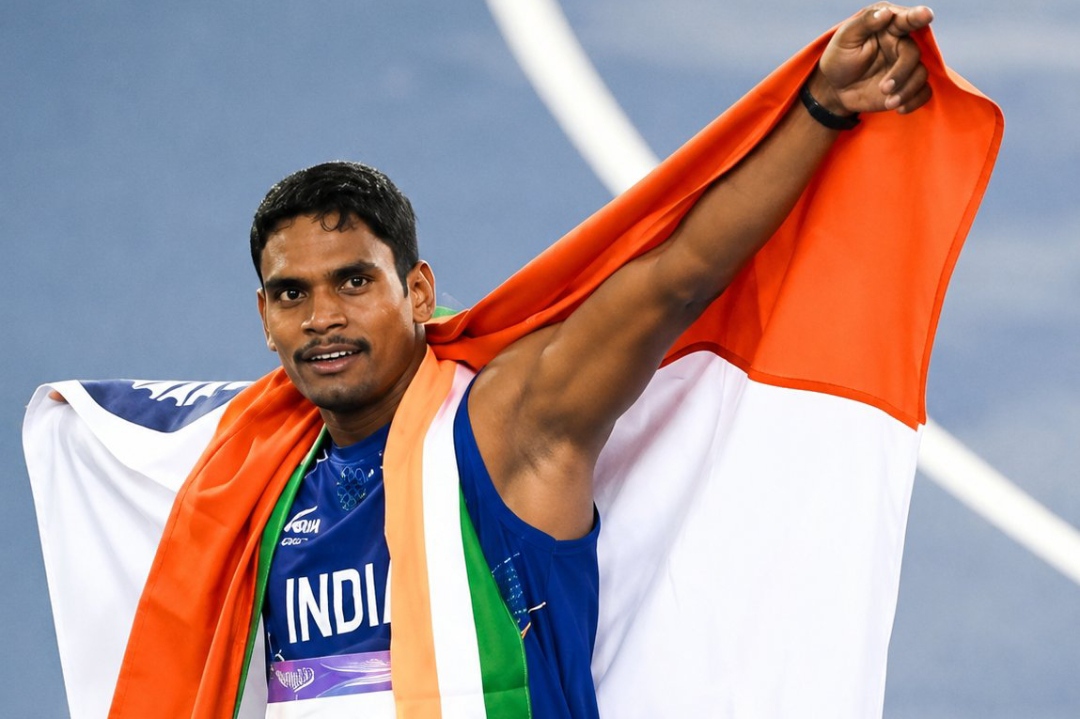
Kolkata: India scripted history in para athletics at the Commonwealth Games, securing a historic one-two finish in the men’s 100m T47 final as Dilip Mahadu Gavit won the gold and Mohammed Basil Morssinganakath claimed the silver. Gavit clocked a Games record and season-best time of 10.71 seconds to take the top spot, while Basil produced his season-best 10.83 seconds to finish second in a closely-fought race. England’s Kevin Santos completed the podium with 10.85 seconds to win bronze. The gold was India’s third at the Glasgow Commonwealth Games, following Mirabai Chanu’s victory in the women’s 48kg weightlifting event and Sharmila Dhankar’s triumph in the women’s shot put F57 para athletics category.
After his historic win, Gavit admitted that the start was not ideal but he grew stronger through the race.
“The start was a bit slow, but then I gradually picked up pace and it felt great to win,” Gavit said.
The final was held on a rain-soaked track, making conditions difficult for the sprinters.
“The weather was not good and I had difficulty getting my timing right. The body becomes slow and it is difficult to warm up,” he said.
Despite the success Gavit is not ready to relax and is already looking ahead to the LA28 Paralympics.
“I am not thinking about doing a job now, my target is to win medals,” he said. “I am sure I will do better at the upcoming Para Asian Games in September-October in Japan and then the Paralympics.” The men’s 100m T47 is a para athletics sprint event for athletes with a unilateral arm impairment or absence, affecting strength, movement or coordination on one side.
But behind Gavit’s gold medal lies a journey shaped by adversity, limited facilities and a chance discovery by his coach.
Born in Toran Dongari, a small village near Nashik, Maharashtra, Dilip lost his right arm below the elbow following a fall from a tree when he was around five years old.
Due to a lack of immediate medical facilities in the area, the injury developed into gangrene, forcing an amputation. The farmlands of Maharashtra present an unrelenting struggle for small farming families, where harsh sun and water scarcity make daily existence precarious.
Dilip recalled those difficult early years after his medal win.
“My family would work as laborers when there was not enough rain to farm our own land, but I couldn’t even do that. I was seen as something useless,” Dilip told after the race.
Yet, despite his disability, Dilip was drawn into the daily grind of village life. Working in the fields built a strong physical engine, and the one thing that brought him solace in a difficult childhood was running. He began sprinting on the dusty dirt roads of his village, where his natural speed eventually caught the eye of local coach Vaijnath Kale.
With limited access to training infrastructure in his hometown, athletics seemed an unlikely path until coach Vaijanth Kale spotted his potential.
“I saw him at school and then I convinced his parents for training,” Kale said after the triumph.
“He did not know anything about para competitions. He was competing in able-bodied events and was doing well.”
Before moving into para athletics, Gavit had already made his mark against able-bodied competitors, winning two medals at the Khelo India Youth Games in Pune and another medal at the Under-18 level.
Kale believes Gavit’s talent was evident from the beginning.
“He would do well in able-bodied meets. The problem in rural areas is that there are no facilities. He did not get proper medical facilities, which led to his left hand being amputated,” he said.
The path from rural farmhand to international champion was accelerated when coach Vaijnath Kale spotted Dilip’s raw speed and convinced his parents to let him move to Nashik for formal training, covering his early living expenses.
As Dilip rose through the ranks, institutional backing scaled his potential. Under the Sports Ministry’s Target Olympic Podium Scheme (TOPS) and the Annual Calendar for Training and Competition (ACTC), Dilip received over Rs 35 lakh in financial assistance.
This funding covered his coach’s salary, specialised equipment, out-of-pocket allowances, and sanctioned exposure trips to seven international competitions – setting the stage for his record-breaking run in Glasgow.
Training in Nashik helped Gavit take his career forward, eventually bringing him to the biggest stage.
A traditional 400m specialist – having won gold at the 2022 Asian Para Games and reached the final at the Paris 2024 Paralympics – Dilip was forced to drop down to the shortest sprint on the programme after the 400m T47 event was omitted from the Glasgow Games.
Switching from a quarter-mile strategy to an explosive 100-meter dash is a massive technical shift, and the persistent rain made it difficult for athletes to adapt to the slick conditions.
Dilip provided the speed, but it was coach Vaijnath Kale who saw beyond the disability, pulling a child out of obscurity and giving him a purpose. In the rain of Glasgow, that belief paid off in gold, proving that with the right guide, even the dustiest roads can lead to the top of the world.
After the race Dilip shared his journey and dedicated the win to his coach on the auspicious occasion of Guru Purnima.
“I come from a small village, Toran Dongari near Nashik. Initially, I was doing farm work in the village. Then, my sir (Vaijanath Kale) saw me running and asked me to come to Nashik for training. He said he would handle everything, including the expenses. Today is Guru Purnima, so this medal is a gift for my Guru.”