

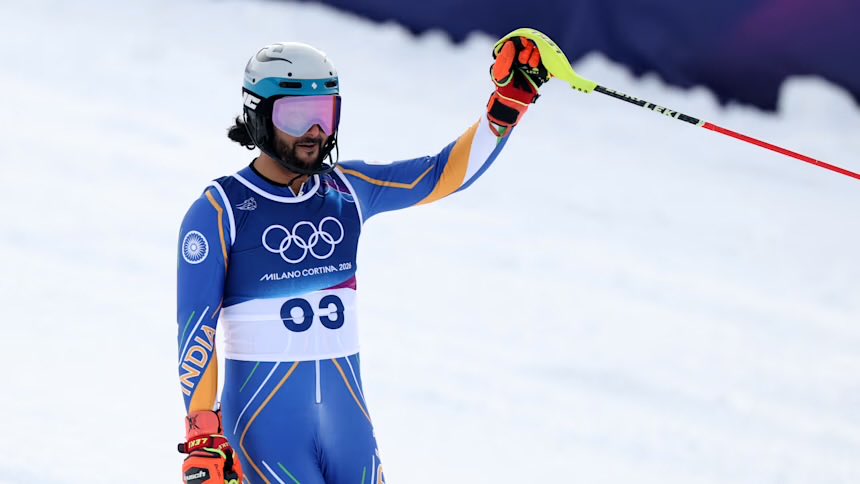
Kolkata : The Milan‑Cortina 2026 Winter Olympics witnessed a historic day for India as alpine skier Arif Mohammad Khan delivered the nation’s best-ever performance in Olympic slalom history. Competing against the world’s elite, Arif finished 39th in the men’s slalom , completing both runs with a combined time of 2:41.60 . His impressive second-run improvement from 44th to 39th placed him ahead of many seasoned athletes and marked a milestone for India in winter sports.
The 35-year-old, who also led the Indian contingent as flag-bearer during the Opening Ceremony, has set a new benchmark and inspired hope for the country’s future in snow sports.
The previous best finish by an Indian man in Olympic slalom belonged to Kishore Ratna Rai, who finished 49th at the 1988 Winter Olympics in Calgary with a time of 2:52.21. Khan’s result not only surpasses that mark but also underscores the incremental progress Indian athletes are making in winter disciplines historically dominated by European powerhouses.
India’s overall best slalom finish at the Winter Olympics remains Shailaja Kumar’s 28th place in the women’s event at Calgary 1988, where she clocked 2:52.27. Khan’s effort now stands as the strongest men’s equivalent performance in the discipline.
Switzerland’s Loïc Meillard clinched gold with a blistering combined time of 1:53.61 nearly 48 seconds faster than Khan. Austria’s Fabio Gstrein took silver in 1:53.96, while Norway’s Henrik Kristoffersen secured bronze with 1:54.74.
The gap between medal contenders and developing ski nations like India remains substantial, but context is critical. Alpine skiing infrastructure, training ecosystems, and competitive exposure differ vastly across nations. For an Indian athlete competing without the depth of systemic backing available in Europe, completing both runs cleanly on Olympic terrain is itself an achievement of note.
Arif Khan’s performance is the defining story of the day. His historic finish in Milan‑Cortina is more than a personal achievement, it represents the growing presence and potential of Indian athletes in winter sports, offering inspiration and a vision for future generations to follow on icy slopes worldwide.
The Milan Cortina Games marked Khan’s second Winter Olympic appearance. At the Beijing 2022 Winter Olympics, he did not finish the slalom event but managed a 45th-place finish in the giant slalom also India’s best-ever result in that discipline at the time.
His journey to the Games has not been conventional. Without a robust winter sports ecosystem at home, Khan has relied on personal determination, overseas training stints, and even crowdfunding initiatives to sustain his Olympic ambitions. That makes his latest result not just a sporting statistic, but a testament to resilience.
Khan’s race also brought India’s campaign at the 2026 Winter Olympics to a close. Earlier, Stanzin Lundup had finished 104th in the men’s 10km freestyle cross-country skiing event. While India remains a peripheral presence in winter sport medal tallies, performances like Khan’s suggest incremental movement. In disciplines where participation itself is a structural challenge, finishing among the top 40 globally carries weight.
For Indian winter sport, the story is not yet about podiums. It is about presence, progression, and pushing historical benchmarks forward. On Monday in Milan Cortina, Arif Mohammad Khan did precisely that.